Showing posts with label Patents Court Guide. Show all posts

5 April 2014

Holding your Own - How to stop others from ripping you off if you are a Private Inventor

Sheffield Central Library, Monday 7 April 2014 18:00 - 19:45


On Monday 7 April 2014 at 18:00 I shall deliver a talk to Sheffield Inventors Group at the Business and IP Centre of Sheffield Central Library on how to stop others from ripping you off if you are a private inventor.

Until very recently the blunt answer to the question "How can I stop others from ripping me off?" was "You can't". That was because the cost of proceedings in the Patents Court or even the Patents County Court was prohibitive. Litigation in common law countries such as England and the United States has always been more expensive than in civil law countries like France, Germany and the Netherlands.  Moreover, in England the losing party usually has to pay the winning party's costs whereas in the USA it does not.  Moreover, lawyers in the USA have always been allowed to accept instructions upon the promise of a share in any damages that may be awarded whereas until recently English lawyers were not. All of those factors combined to make England one of the most expensive and hazardous jurisdictions for individuals or small or medium enterprises ("SME") to enforce their intellectual property rights ("IPR") in the world,

Up to 2002 that did not matter so much because legal aid was available for IP claims as it was for most civil proceedings. In April of that year paragraph 1 (h) of Schedule 2 to the Access to Justice Act 1999 came into effect which abolished public funding for matters arising out of the carrying on of a business.  Word quickly spread that enforcing a patent or other IPR was too expensive and too risky for all but wealthy individuals and big companies and organizations.  Consequently, fewer and fewer individuals and SME bothered with patent applications with the result that the country of Newton and Faraday now trails not only Germany and France but even the Netherlands with one third of our population and Switzerland with one eighth in the number of applications to the European Patent Office (see "Why IP Yorkshire" 10 Sep 2008).

Since I wrote that article there have been a number of changes that make it cheaper and easier for individuals and SME to protect themselves. First, the costs that a successful party can recover from the other side  in the Patents County Court were capped at £50,000 on 1 Oct 2010 (see "New Patents County Court Rules" 31 Oct 2010 NIPC Law). Secondly, a new small claims track in the Patents County Court was launched on 1 Oct 2012 for claims up to £10,000 (see "Patents County Court - The New Small Claims Track Rules" 20 Sept 2012 NIPC Law). I gave a talk on this new jurisdiction to the Sheffield Inventors Group in "How Small Businesses in Yorkshire can protect their Intellectual Property" 14 Oct 2012. The Patents County Court was abolished on 30 Sept 2013 but it was replaced by the Intellectual Property Enterprise Court ("IPEC") which operates in exactly the same way and with the same rules as its predecessor. Thirdly, new insurance and funding options are now available which reduce the cost and risk of litigation (see "Intellectual Property Litigation - the Funding Options" 10 April 2013 NIPC Law). Finally, HM Government has entered an agreement with most of its EU partners to set up a Unified Patents Court which will hear disputes over unitary patents (European patents treating the territories of the contracting states as though they were one country) (see "Unified Patent Court Comes One Step Closer" 17 Aug 2013 NIPC Law).

In my talk on Monday I shall discuss:

  • the Institutions: the Intellectual Property Office, European Patent Office, Chancery Division, Patents Court and IPEC;
  • the Legislation: the Patents Act 1977 and other IP statutes, the European Patent Convention, Part 63;
  • Practice: Patents Court, Chancery and IPEC Guides;
  • Claims for breach of confidence: How to bring proceedings in IPEC's small claims track;
  • Entitlement Proceedings
  • Infringement Proceedings in IPEC and the Patents Court
  • Threats Actions
  • Revocation Actions
  • Insurance
  • Unified Patent Court.
I shall explain each of these concepts and steps in everyday non-technical language with links to other materials and I shall later post the slides to this website. 

I do hope to see as many readers as possible on Monday but if you can't make it and want to discuss any of these points don't be afraid to give me a ring on 020 7404 5252 during office hours or send me a message through my contact formtweet me, write on my wall or get in touch through G+, Linkedin or Xing.

10 July 2013

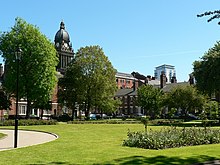
IP Litigation in Leeds - Past, Present and Future

Source Wikipedia 


Unlike Lancashire, Durham and Northumberland, Yorkshire did not have a palatinate court before the Courts Act 1971. Consequently no intellectual property or other chancery litigation could be conducted in Leeds until after the Durham and Lancaster Palatinates Courts had merged with the Chancery Division . After that merger, Judge Blackett-Ord and his deputies Judges Fitzhugh and O'Donoghue heard chancery business in Leeds as well as Liverpool, Manchester, Newcastle and Preston. Those judges did not spend all their time in the High Court. They also sat in the county courts and even in the Crown Court.

When Judge Blackett-Ord retired in 1987 the government of the day considered the abolition of the chancery jurisdiction in the North altogether.  Chancery practitioners in Leeds and Manchester under the leadership of my deputy head of chambers Peter Keenan and supported by James Allen and John Behrens (who were then the leading and indeed practically the only chancery practitioners in Leeds) produced alternative proposals to which I contributed the economics section. These were accepted by the Lord Chancellor who appointed Sir Richard Scott as Vice-Chancellor of the County Palatine of Lancaster. In that role Sir Richard sat on at least one interim applications (or motions) day and some of the more important trials in Leeds.

There had always been a number of building societies in West Yorkshire. The Building Societies Act 1986  allowed them to demutualize and become banks. As most of the other great cities of the North of England declined with the contraction of manufacturing Leeds found a new role as a financial centre. Those financial institutions and the businesses and professional practices that supported them required sophisticated legal advice on all aspects of commercial law locally. Local demand for commercial legal services catapulted firms like Booth & Co, Dibb Lupton, Hammond Suddards, Hepworth & Chadwick and Simpson Curtis into major international practices.

Several of those firms had excellent intellectual property and technology lawyers such as Richard Sutton and Simon Chalton at Dibb Luton and Dai Davis at Hepworth & Chadwick. They trained many other good IP lawyers in Leeds. While most of their work went to London some of it was remained in Leeds. As the only IP practitioner outside London at that time much of it came to me.

S.61 (1)  and paragraph 1 (i) of Schedule I to of the Senior Courts Act 1981 allocated intellectual property cases to the Chancery Division. S.6 (1) (a) of the Act established the Patents Court as part of the Chancery Division while s.62 (1) and assigned to it
"such proceedings relating to patents as are within the jurisdiction conferred on it by the Patents Act 1977, and such other proceedings relating to patents or other matters as may be prescribed."
S.287 (1) of the Copyright, Designs  and Patents Act 1988 enabled the Minister of Justice to
"designate any county court as a patents county court and confer on it jurisdiction (its “special jurisdiction”) to hear and determine such descriptions of proceedings—
(a) relating to patents or designs, or
(b) ancillary to, or arising out of the same subject matter as, proceedings relating to patents or designs,
as may be specified in the order."
Only the Edmonton and Central London County Courts have ever been designated as patents county courts and there has only been one county court for the whole of England and Wales at any one time.

CPR 63.2 (2) requires patents, registered and registered Community designs, semiconductor topography and plant varieties claims to be brought in the Patents Court and Patents County Courts. All other intellectual property cases must be brought in the Chancery Division (which of course sits in Leeds) and any county court where there is also a chancery district registry (which includes Leeds County Court) pursuant to CPR 63.13. 

Until 30 Sept 2010 the Patents County Court was almost as expensive as the Patents Court. In its report "The Enforcement of Patent Rights" of November 2003, IPAC (the Intellectual Property Advisory Committee) reported at page 50 that the average cost of an action in the Patents County Court was between £150,000 and £250,000. Where the claimant was in Yorkshire there were considerable cost savings in litigating in Leeds.

That advantage disappeared on 1 Oct 2010 with changes to CPR Parts 63 and 44 that expedited the procedure and limited the costs of litigation in the Patents County Court (see my article on the "New Patents County Court Rules" 31 Oct 2010 NIPC law). With the new small claims track for IP cases which was launched on 1 Oct 2012 there was even less incentive to litigate in Leeds (see Jane Lambert "The New Small IP Claims Jurisdiction" 5 March 2012).

However, this may change. The Patents County Court is now very busy with long waits for case management conferences and trial dates.   S.17 (1) of the Crime and Courts Act 2013 establishes a single County Court for England and Wales with national jurisdiction that can sit anywhere pursuant to Schedule 9. Paragraph 4 of the Patents Court Guide already provides that:
"If the parties so desire, for the purpose of saving time or costs, the Patents Court will sit out of London."
Paragraph 1.5 of the Patents County Court Guide contains a corresponding provision. There is no reason why the Minister of Justice should not appoint one or more circuit judges or recorders with experience of patents to hear IP cases in Leeds or indeed anywhere else in England or Wales for that matter. Similarly, there is no reason why a district judge should not be appointed to hear small IP claims in Leeds or other towns and cities.

Although I have now joined 4-5 Gray's Inn Square, I still live in Holmfirth, I can still be consulted at the Huddersfield Media Centre and I can still appear for you at short notice at the Leeds Combined Court Centre. Should you wish to discuss this post please  complete my contact form or by call me on 01484 599090 or 0113 320 3232..