Showing posts with label IPO. Show all posts

28 February 2025

The Interface between Copyright and Design Law


Jane Lambert

The guest of honour at yesterday's dinner meeting of The Intellectual Property Society of Yorkshire ("TIPSY") was Jonathan Moss of Hogarth Chambers.  The title of his talk was Rowing Uphill? The UK Position on Copyright in Works of Industrial Handicraft or Applied Art.  Rowing Uphill? was clearly a reference to Mr Campbell Forsyth's judgment in WaterRower (UK) Ltd v Liking Ltd. [2024] EWHC 2806 (IPEC)  in which Mr Moss represented the defendant.  That was not quite the same as the title of the advertised talk "Is copyright making a comeback for the protection of industrially produced items?” which referred to Ian Karet's judgment in Equisafety Ltd v Woof Wear Ltd [2024] EWHC 2478 (IPEC) (25 Sept 2024) as well as WaterRower but Mr Moss's talk was still jolly interesting all the same.  Coming two days after the launch of the IPO's Survey on priorities to shape UK system for protecting designs which I discussed in NIPC News yesterday the timing of Mr Moss's talk could not have been better.

Mr Moss divided his talk into three parts:

  • Part I: Cofemel, Brompton and the copyright/design interface
  • Part II: The Position following WaterRowe v Liking
  • Part III: The Future?
Cofemel referred to C-683/17 Cofemel – Sociedade de Vestuário SA v G-Star Raw CV [2020] ECDR 9, EU: C:2019:721, ECLI:EU: C:2019:721, [2019] EUECJ C-683/17 and Brompton to Case C-833/18 SI, Brompton Bicycle Ltd and another v Chedech/Get2Get [2020] ECDR 10, [2021] CEC 670, EU: C:2020:461, ECLI:EU: C:2020:461, [2021] 1 CMLR 2, [2020] FSR 36, [2020] Bus LR 1619, [2020] EUECJ C-833/18.  These are two important judgments of the Court of Justice of the European Union to which Mr Forsyth referred in WaterRower.   I should add that Mr Karet also considered those cases in Equisafety.   The "copyright/design interface" referred to the fact that some industrial designs can also be protected by artistic copyright.  Mr Moss illustrated the point with a picture of a bookcase from his study which contained items that were definitely protected by copyright such as books but also ornaments that could be protected by design law. To underscore the point he referred to art 2 (7) of the Berne Convention and art 17 of the Designs Directive (Directive 98/71/EC of the European Parliament and of the Council of 13 October 1998 on the legal protection of designs OJ L 289, 28.10.1998, p. 28–35)).  Mr Moss took us through the Court's decision in Cofemel and Brompton Bicycle.

In Part II Mr Moss took us through WaterRower which is a case that I discussed in The Trial - WaterRower v Liking on 20 Nov 2024 in NIPC Law. Before discussing Mr Forsyth's judgment he summarized Judge Hacon's judgment in Response Clothing Ltd v The Edinburgh Woollen Mill Ltd. [2020] WLR(D) 88, [2020] EWHC 148 (IPEC).  In that case, the learned judge held that the Marleasing principle could be used to make the EU test for a copyright work within the meaning of art 2 of the Information Society Directive with the test of artistic craftsmanship within the meaning of s.4 (1) (c) of the Copyright, Designs and Patents Act 1988,  For those who want a bit more detail on the point, I wrote about Response Clothing in Copyright: Response Clothing Ltd v The Edinburgh Woollen Mill Ltd. in NIPC Law on 31 Jan 2020.  Mr Moss said that Mr Forsyth had held in WaterRower that:

  1. Artistic craftsmanship under s.4 (1) (c) CDPA could not be read in line with the Cefemel line of case law.
  2. The WaterRower was not protected as a work of artistic copyright because it was intended for commercial use and the designer did not have the necessary characteristics of an artist-craftsman.
  3. The WaterRower would have been protected under Infosoc and Cofemel.
Part III consisted of a picture of the Royal Courts of Justice and one slide which considered:
  • The possibility of future cases of pleading copyright works that fall outside the closed categories of the CDPA;
  • The test of intellectual creation as a gateway test when it comes to works of artistic craftsmanship;
  • It is still unclear what exactly is the test for artistic craftsmanship; and
  • The IPO's announcement of further consultation on the design/artistic copyright interface.
Surprisingly, there was only one question from the floor and that came from me.   As a patent had been granted for the WaterRower I asked whether Mr Moss had considered the point that Mr Justice Whitford (a former head of my previous chambers) had raised at first instance in Catnic Components Ltd. v. Hill & Smith Ltd. [1982] RPC. 183  that an applicant for a patent dedicates any copyright that may subsist in his patent drawings to the public. The answer was that the point had been considered and even raised but it was not properly developed because of the time limitations in the Intellectual Property Enterprise Court.

An additional bonus was that I was seated at a table with some very interesting companions.  The lady next to me was a Ukrainian national who had read law at one of the best law schools in Ukraine and the University of Dundee which had been a college of my alma mater until 1967.  As Andrew Clay is also a St Andrean I introduced my companion to him.  He already knew the lady's sister who was also at the dinner and whose acquaintance I subsequently made.   I invited both ladies to chambers whenever they have some spare time in London during a working day.  As my companion worked for  Womble Bond Dickinson I also introduced her to Patrick Cantrill who had once headed the intellectual property team at that firm and to Michael Harrison, Past President of the Chartered Institute of Patent Attorneys.

My only disappointment was that prices seem to have skyrocketed and standards of service seem to have nosedived at the Leeds DoubleTree Hilton.  The cost of the dinner meeting on 27 Nov 2024 was £68 and we got to hear a Lord Justice of the Court of Appeal, a cloakroom, Christmas crackers and party hats (although Mr Harrison and I were the only diners who wore them) and coffee.  Yesterday's cost £75.  We had nowhere to put our coats and above all we had no coffee.  The hotel is very convenient for Leeds mainline railway station though it is not always possible to park in or around Granary Wharf.  However, I would not object to our meetings taking place at a less expensive venue possibly in Bradford or some other city.

Nevertheless, I am very grateful to our organizer, Andrew Clay, for setting up and running TIPSY.  He has kindly agreed to speak to the St Andrews students' Law Society on 14 April 2025.  I intend to motor up to the auld grey toon that  Andrew Lang described so poignantly in Almae Matres in order to hear Andrew's talk.

Anyone wishing to discuss any of the topics referred to by Mr Moss or me should call me on 020 7404 5252 during UK office hours or send me a message through my contact form.

7 November 2019

Barnsley Pro Bono IP Clinic 12 Nov 2019

Flowers from a happy client


Jane Lambert

Not all my clients send me flowers after a free 30-minute consultation at the Business Village at Wilthorpe in Barnsley but several have done so in the past.  This photo of me holding an unexpected bouquet from a more than satisfied client was taken at the Business Village's reception desk.

On the second Tuesday of every month between 16:00 and 18:00, I hold up to 4 free consultations of 30 minutes each with entrepreneurs, inventors and other creative people who require advice or assistance on IP law.

Enquiries can be of any kind.  For instance, an inventor of a new product may want to know whether it is patentable. I can't give him or her a complete answer in 30 minutes but I can tell the inventor the basic principles of patent law, advise about searches, how and where to apply, the likely costs in the Intellectual Property Office and European Patent Office and applications under the Patent Cooperation Treaty, the advantages of instructing a patent attorney and how they can be found and free or cost-effective business services through the Business and IP Centres at Leeds and Sheffield.

Sometimes the client needs services from another professional such as a product design consultant or a specialist insurance broker.  I can help point him or her in the right direction,  I have been running this clinic for the last 12 years and I have built up an enormous list of contacts in Yorkshire and beyond over that time.

My next clinic will take place on 12 Nov 2019 and I have slots between 17:00 and 17:30 and between 17:30 and 18:00.  If you want to take advantage of one of those slots fill in my Barnsley IP Clinic form and send it off as soon as possible.  I will give you an appointment as soon as I hear from you.  Alternatively, you can call the Business Village on 01226 249590 and ask to speak to Megan Winslow. If we can't fit you in this month we can offer you an appointment at the December clinic.

The Business Village is about a mile and a half from the centre of Barnsley and on several bus routes.  It is not far from the M1 and has plenty of free parking in the Village itself or in neighbouring streets. If you want to discuss this article or my service generally call me 020 7404 5252 during office hours or send me a message through my contact form. 

12 January 2018

Northern Max - a new Healthcare Accelerator in Bradford

Bradford Royal Infirmary


Source Wikipedia


Jane Lambert

In Accelerators and Incubators in the Leeds City Region 22 April 2017 IP Yorkshire I wrote:
"Both accelerators and incubators help to launch fledgling businesses. Accelerators offer structured development and training with opportunities to attract funding for the most attractive businesses. Incubators are more like serviced offices with mentoring and other forms of business and technical support thrown in."
When I penned that article there were only four accelerators and all of them were in Leeds. I can now report the launch of a new one in Bradford for the healthcare industry called Northern Max. It came to my attention through a posting on the Yorkshire Business Desk: SMEs and start-ups embark on programme to bring innovative health solutions to market 12 Jan 2018

Northern Max describes itself as "a market-access focused 12-week accelerator programme that has been funded by City of Bradford Metropolitan District Council and AD:Venture."  AD:Venture supports start-ups and young business in their first 3 years of trading,within the Leeds City Region. Such support consists of "a tailored mix of practical advice, coaching, outcome focused events, academic support, incubation work space, finance brokerage, low rate loans and help".

The accelerator programme started on 8 Jan 2018 at the Digital Exchange in Little Germany. Businesses participating in the programme will have an opportunity to:
  • validate their technology and business models;
  • create and test minimum viable products; and
  • be introduced to potential customers, funders and investors.
They should leave with a clear understanding of growth strategy, funding options and market opportunities. At least some should have secured some sort of funding and all will have tested their assumptions in live NHS and care settings, and pitched to potential customers and investors.  The programme will be provided by Innov8tive Minds and the Digital Health Enterprise Zone ("DHEZ").

Neither the The Business Desk article nor the announcements on the AD:Venture or the DHEZ websites state whether participating businesses will be made aware of the dangers of inadvertently infringing other businesses' patents, trade marks or other intellectual property rights or of competitors exploiting their intellectual assets through failing to protect then properly, If they have not been alerted to those dangers, they should be.

Happily, the Intellectual Property Office ("IPO") has recently updated its IP Basics guidance.  The best time to start thinking about these matters is when writing a business plan.  As the IPO notes:
" Your business builds goodwill and recognition through your brand, product or service. This value builds up over time and becomes integral linked to your business’s IP assets. If used well, IP can offer a solid platform for any business to grow. How you plan, manage and protect your ideas should be a crucial feature in your business planning. What seems unimportant today could be worth millions of pounds in the future, if protected."
Businesses on the Northern Max programme can find additional information on how to incorporate IP into their business plans in Jane Lambert Putting IP at the Heart of Your Business Plan 2 Jan 2015 NIPC News and Jane Lambert Why every business plan should take account of intellectual property 3 April 2016 NIPC News,

In Getting Help, the IPO advises that the British Library Business and IP Centre supports entrepreneurs, inventors and small businesses and will also give advice on creating a business plan. The British Library works with a number of public libraries around the country to provide similar advice locally at Business and IP Centres. The nearest Centre to Bradford is at Leeds Central Library.

Sometimes businesses need specialist professional advice and it is there that enormous care should be taken. Businesses requiring patents should consult a patent attorney and those needing trade marks a trade mark attorney. Law firms that are members of the Intellectual Property Lawyers Association can advise on licensing, joint ventures, funding and other business transactions, They can also assist parties to resolve infringement and other disputes.  Barristers who subscribe to the Intellectual Property Bar Association support patent and trade mark attorneys and solicitors by advising on difficult points of law, drafting complex legal instruments and presenting cases before judges and hearing officers much in the way that consultant physicians and surgeons support GPs in medicine (see Jane Lambert IP Services from Barristers 6 April 2013 NIPC News).

I wish Innov8tive Minds, DHEZ, participating businesses and everyone involved in the Northern Max project every success.  Should any of them wish to discuss this article or IP generally they should call me on 020 7404 5252 during office hours or send me a message through my contact page.

17 May 2017

How to Access Useful Cost-Effective IP Services in Yorkshire

Percy Shaw's Cats' Eyes - Possibly Yorkshire's most
famous invention
Author ELIOT2000
Source Wikipedia 


Jane Lambert

Our national prosperity depends on the competitiveness of British industry and that, in turn, depends on the propensity of our businesses to create and innovate.  Start ups and other small and medium enterprises ("SME") are among the most creative and innovative businesses in our economy.  They need to protect their investment in branding, creativity, design and innovation with intellectual property rights just as much as any other business but they do not appear to do so.  According to the European Patent Office, only 5,142 European patent applications originated from the UK in 2016 which is only 163 more than in 2007. In that time we have slipped from 7th place in the number of European patent applications to 9th having been overtaken by China and South Korea in our own backyard.

Soon after it entered office, the Coalition government commissioned Prof. Ian Hargreaves to review how the intellectual property framework supports growth and innovation and, in particular, "the cost and complexity to SMEs of accessing IP services to help them to protect and exploit IP". Hargreaves found 3 issues that impede SME in obtaining the support they needed:
  • the complexity of available offerings; 
  • a lack of broad-based, strategic business advice; and 
  • the substantial costs involved in IP management.
He recommended that:
"The IPO should draw up plans to improve accessibility of the IP system to smaller companies who will benefit from it. This should involve access to lower cost providers of integrated IP legal and commercial advice."
Although the government accepted that and all Hargreaves's recommendations, not much has been done to implement it.  Arguably access to IP services is worse now than it was when Hargreaves delivered his report because Yorkshire Forward and Business Link Yorkshire which signposted entrepreneurs and other business owners to the appropriate services and often funded them was abolished shortly after Hargreaves delivered his report.

The gap left by Business Links and Yorkshire Forward has been partly filled by the PatLib Centres at the Leeds, Sheffield and Hull Central Libraries which have been re-branded as Business and IP Centres in association with the British Library and funded by Arts Council England.  According to the British Library website:
"The British Library Business & IP Centre National Network provides entrepreneurs and SMEs across the UK with free access to databases, market research, journals, directories and reports worth thousands of pounds. There is a programme of free and low-cost events and workshops on a range of topics including business planning, marketing and intellectual property."
The British Library also hosts Linkedin and Facebook groups which carry useful articles and discussion.

So what does an entrepreneur, inventor, business angel do now if he or she wants to access the sort of cost-effective integrated business advice that Prof Hargreaves recommended?  Well here are my tips.

Tip #1.   Find out as much as you can about IP generally before you seek professional advice.
A good starting point is the IPO section of the Government website.  Particularly useful pages are:
I also recommend the IPO's IP Basics animations such as What is Intellectual Property? which you will find on the IPO's YouTube channel. If you want to learn more about protecting your intellectual assets outside the UK, a good place to start is the Protecting your UK intellectual property abroad page on the IPO website. The IP BASICS: Should I protect my Intellectual Property overseas? video is also worth watching. You will also find useful information on the European Patent Officee, EU Intellectual Property Office and World Intellectual Property Office websites. Each of those sites will introduce you to other resources. You can get a very thorough grounding in IP law from those and other materials.

Tip #2   Attend a Workshop or Seminar
Each of the Business and IP Centres in Yorkshire holds workshops and other events on IP law. I give one at Barnsley Business and Innovation Centre ("BBIC") in conjunction with BarnsleyBiz Surgeries on the second Tuesday of every month between 17:45 and 18:30. The IPO also holds regular events which you will find on the IPO events calendar.

Tip #3  Attend an IP Clinic
These are free consultations with a patent or trade mark attorney or a special st lawyer that would otherwise cost you quite a lot of money. The Chartered Institute of Patent Attorneys holds clinics once a month at Leeds and Sheffield Central Libraries (see the IP Clinics page of the CIPA website) and I hold one on the second Tuesday of every month at Barnsley BIC between 16:00 and 17:45. If you want a 30 minute consultation with me call George on 020 7404 5252.

Tip #4  Get a Search before consulting an IP Professional
You can only get or keep a patent if your invention is new and not obvious having regard to what what is already known. You can find out what has been invented before and what was known by searching the prior art. That is essentially a search of the register of British, European and other patents.  Similarly, you can only register a trade mark or keep a trade mark registration if the same or similar mark has not been registered for the same or similar goods or services. You can find out whether such a mark has been registered by searching the British, EU and WIPO registers. Finally, you may lose any design registration that you may obtain if the similar designs have been registered before. Leeds and Sheffield Business and IP Centres will carry out searches for you for a very reasonable fee. Call 0113 378 6010 for further details.

Tip #5  Consult a Regulated Professional
There are a lot of people who offer advice and assistance on IP but not all are reliable. In particular, there are businesses or individuals who promise the earth, charge a hefty fee and then supply information which is either wrong or available from other service providers free of charge or for a much lower fee or fail to deliver altogether. You should be on the lookout for them and avoid them like the plague. 

There are, however, other advisers who follow a code of conduct enforced by a professional regulator which requires them among other things to insure against the consequences of negligent advice. These are patent and trade mark attorneys and specialist counsel and solicitors. 

Although there is considerable overlap in the work that members of each of those professions carry out, there are differences in training and experience that equip members of one profession to perform a particular task better than any of the others. For instance, patent attorneys have natural science, engineering or technology qualifications as well as legal ones and are trained to draft patent specifications in a way that  is clear enough and complete enough for the invention to be performed by a person skilled in the art and claims that afford the widest possible monopoly while remaining valid. Similarly, barristers are trained as advocates which equips them to present cases to judges and hearing officers. They are therefore well placed to advise on difficult points of law and draft complex legal instruments which they are often instructed to do by members of the other professions. All the judges of the Patents Court, Intellectual Property Enterprise Court and the rest of the Chancery Division practised at the Bar before their elevation to the bench (see Jane Lambert IP Services from Barristers 6 April 2013).

Patent attorneys are members of the Chartered Institute of Patent Attorneys whose website has a searchable databases of patent agencies. Trade maek attorneys belong to the Chartered Institute of Trade Mark Attorneys who also have a Find an Expert feature. Most barristers who specalize in IP law belong to the IP Bar Association  Many but by no means all law firms that specialize in IP are members of the Intellectual Property Lawyers Association.

Tip #6  Ensure Adequate Funding for Litigation
Enforcing or defending IP rights can be expensive even in IPEC and the IPO. Because of the length and uncertainties of litigation very few cases are undertaken on a "no win no fee" retainer, particularly as success fees and after-the-event insurance premiums are no longer recoverable under the Legal Aid, Sentencing and Punishment of Offenders Act 2012 (see Jane Lambert Intellectual Property Litigation - The Funding Options 10 April 2013 NIPC Law), It is therefore prudent for businesses to consider before-the-event insurance when they apply for patents, trade marks or registered designs or when they create a copyrught work or original design. For information on IP insurance, see IP Insurance, CIPA's paper 1 May 2016.

For fiurther information, call me during office hours on 020 7404 5252 or send me a message through my contact form.

10 April 2017

CIPA York Meeting

Brighter Days in York?
(c) 2016 Jane Lamber: all rights reserved


Last Thursday I was one of the speakers at the York meeting of the Chartered Institute of Patent Attorneys ("CIPA"). The other speakers were Louise Edwards of Mazars, David Bloom of Safeguard IP and Kalim Yasseen who is a patent examiner with the Intellectual Property Office. CIPA's president, Tony Rollins, chaired the meeting.

I spoke about IP Litigation after Brexit.  Although we Brits tend to be seen as the awkward squad when it comes to the European project there has been one initiative upon which we have been commendably communautaire. That initiative has been a single European patent for all the member states of the European Union with a single court for the resolution of disputes relating to such patents. The reason why we have always supported that initiative is that patent enforcement litigation in the UK is the most expensive in Europe. The cost of enforcement probably has a lot to do with why the UK trails not just Germany and France in the number of European patent applications but also Switzerland with one eighth of our population and the Netherlands with one third. Something that I have been saying for most of the last 10 years (see Why IP Yorkshire 10 Sept 2008),

The Uniform Patent Court, which will probably come into being towards the end of this year or the beginning of next, would have put British industry on a level playing field with its continental competitors. Unfortunately, the chances are that we shall have to leave when we quit the EU. After we go it will be even more important to do something about reducing the cost of IP litigation in the UK. One solution will be to make better use of the Intellectual Property Enterprise Court ("IPEC") and, in particular, its small claims track. Another consequence of Brexit is that we shall be looking for new export markets outside Europe where the IP environment will be quite different. Not all those markets protect intellectual assets adequately and I suggest that the UK's bilateral investment treaties with 117 foreign states might help. I discussed all these items in greater detail in IP Litigation after Brexit 9 April 2017 IP North West).

Louise gave is a Patent Box Update in which she discussed the effects of the Finance Act 2016 and proposed Finance Bill and considered a number of case studies. She covered some of the rules on patent box relief contained in the 2016 Act and gave us some statistics on take-up. There were apparently 55 companies that took advantage of the scheme in North West England but rather more in Yorkshire. She mentioned the base erosion and profit shifting project of the OECD and how it will affect IP and in particular licensing and distribution. Finally, Louse spoke about three cases that were on her desk right now. One concerned an "ideas company" and its licensing activities. Another, a patentee who had found a new use for his (or her) invention. Finally, a "serial inventor" who insisted on holding onto his IP even though it was not at all tax efficient.

Louise illustrated her talk with bear traps, signposts to "opportunities" and gold nuggets of which there were many. She also had a short sighted computer literate bespectacled terrier under the caption "No tax tail wagging me!" A useful reminder that tax schemes with the primary purpose of avoiding tax will not be bought by HMRC or, for that matter, the courts.

David spoke about IP insurance which is a topic very dear to my heart. I have written quite a lot of articles about it over the years, the last being IP Insurance: CIPA's Paper 1 May 2017 NIPC Inventors' Club. In my view, there is no point in spending a lot of money on obtaining a patent unless you are prepared to enforce it. Despite IPEC and the UPC which I mentioned in my paper it still costs an arm and a leg to enforce an IP right in England. IP insurance can help with that and David said that the choice of insurance products was going up and the cost of premiums was going down. At one time, patent agents used to warn their clients not to waste their money on insurance. I am glad to say that I don't think they do that anything like as much nowadays. If I were a patent or trade mark attorney I would make all my clients aware of such things as IP insurance and watch services and point them in the direction of someone who could give them some dispassionate advice and information.

Kalim, whom I had met when he gave a super talk to the Sheffield inventors club entitled "Filing a UK patent application - process and procedures" on 6 Feb 2012, discussed changes to the Patents Rules 2007 some of which were coming into effect that very day (see Changes to Patents Rules on 1 October 2016 and 6 April 2017 1 Sept 2016 IPO website). These included "omnibus claims" - not an application for a patent for a new kind of charabanc but a basic repetition of the description in the specification - and the communication of patent renewal reminders. Some of these new rules such as the examiner's notification of intention to grant seem to me to be very useful and most have actually been in force since October.

Kalim also spoke about changes to the IPO's portion of the .gov.uk website which seems to reinstate some of the useful bits of the old professional pages section of the IPO's old website. One useful feature is password protected access to the examiner's file. Another is the updating of the Manual of Patent Practice.

Finally, Kalim gave us some tips on working with your examiner. He assured us that he and his colleagues were quite approachable and perfectly reasonable but there are some things that get their goats of which we should be aware. Fairly common sense things in my view.

The meeting took place in the Principal Hotel next to the station. It seems to have undergone considerable renovation and refurbishment. It was much smarter than it was when I last visited it. They laid on a hot and cold buffet with soft drinks for lunch, tea and coffee at half time and gallons of prosecco for those who did not have to drive. Patent seekers generously added some Welsh whisky, easter eggs and chocolate bunnies to the festivities and we were well away. As I was precluded from partaking in the whisky, I was tempted to mention Mr Justice Laddie's decision in Matthew Gloag and Son Ltd and Another v Welsh Distillers Ltd and Others: The Runes 27 Feb 1998 but thought better of it.

20 July 2014

Well at least a Yorkshireman invented Cats' Eyes

Source Wikipedia


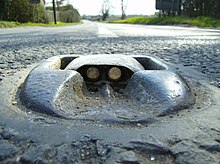
The former Manchester Guardian listed Percy Wood of Halifax as one of the top 50 Yorkshire folk of all time. He invented the reflective road market known as cats' eyes in 1933. Apparently, he got the idea after seeing a real cat's eyes while negotiating the still hazardous road from Clayton Heights to Halifax. Reflectors based on Shaw's invention are found all over the world.

However, there have not been so many inventions from our county recently. According to the Intellectual Property Office's Facts and Figures for 2012 and 2013, some 984 British patent applications were filed from Yorkshire and the Humber in 2013 compared to 1,025 in 2012.  In the same year there were 2,822 applications from South East England, 2,588 from London, 1,802 from the East of England, 1,368 from the South West, 1,259 from the North West and 1,180 from the West Midlands. However, Yorkshire was ahead of Scotland (900), the East Midlands (742), Wales (539), North East England (314) and Northern Ireland (237). Yorkshire was also 7th in the number of grants: 171 compared to 437 from South East England, 346 from London, 340 from South West England, 337 from Eastern England, 204 from North West England and 192 from the West Midlands.

There were 2,744 trade mark applications from Yorkshire in 2013 compared to 12,699 from London, 6.197 from South East England, 4,222 from North West England, 3,407 from South West England, 3,227 from the East of England and 2,885 from the West Midlands. With 2,305 registrations in 2013, Yorkshire trails London (10,583), South East England (5,258), North West (3,521), South West (2,951), Eastern England (2,651) and the West Midlands (2,329).

With 78 registered design applications and 59 registrations in 2013 Yorkshire was last but one from the bottom. Only Northern Ireland had fewer applications (19) and registrations (16).  The top three regions for designs were London (1,153 applications and 720 registrations), South East England (1,066 applications and 883 registrations) the North East (548 applications and 484 registrations). North West England had 471 applications and 397 registrations.

We can assist artists, designers, inventors, entrepreneurs and investors in Yorkshire and the Humber with our IP clinics at Barnsley BIC, talks and publications all of which are free of charge. For our chargeable services see "IP Services from Barristers" 6 Apr 2013 4-5 IP. If anyone wants to discuss his article or any patent, trade mark, design or other intellectual property matter he or she should call us on 01484 599090 or get in touch through my contact form. You can also tweet me, write on my wall or send me a message through G+, Linkedin or Xing.

14 October 2013

Business and IP Centre National Network


Leeds and Sheffield Central Libraries are part of The Business & IP Centre national network.  This is a collaboration between the British Library, the Intellectual Property Office and Birmingham, Leeds, Liverpool, Manchester. Newcastle and Sheffield PATLib or patent information centres. I blogged about the launch of the network in "Enterprise and Libraries: a New National Network of Business & IP Support" 8 March 2013 NIPC Inventors Club.

As I said in that article, the establishment of those centres is part of a two-prong strategy to replace the regional development agencies with local enterprise partnerships and local Business Link offices with libraries.  In its press release "Enterprising Libraries: ten library projects receive Arts Council funding to support the development of local businesses" 3 Oct 2013, the Arts Council explained that
"Enterprising Libraries supports local economic growth by turning libraries into spaces for the development of business ideas, providing coaching, advice, meeting spaces and IT support for local businesses and entrepreneurs."
Funding for the project is provided by the Arts Council, British Library and the Department for Communities and Local Government.

Sheffield has already appointed Roger Tipple as an innovator in residence and he addressed the Sheffield Inventors Group last week.  I mentioned one of the topics that he discussed in his talk in "Another Look at Crowd Funding" 13 Oct 2013 NIPC Inventors Club.  Maria Lampert of the British Library will give two talks on intellectual property on the 6 Nov between 09:30 and 11:30 and 12:30 and 14:30 respectively.

30 July 2013

Forthcoming IP Related Events in Yorkshire

~
Yorkshire Puddings     Source  Wikipedia


The Intellectual Property Office has just updated its calendar of events.   The following are taking place in Yorkshire:
Here are some more that I just happen to know about:
Next, there are the regulars:
Finally, there are the patent clinics run by the Chartered Institute of Patent Agents at Leeds and Sheffield Central Libraries and my clinic between 10:00 and 12:00 on the second Tuesday of every month at Barnsley Business and Innovation Centre.

If you want to know about IP events elsewhere in the UK check out the IPO, CIPA and ITMA websites. If anybody wants a speaker from our chambers for an IP related event please contact my clerk Stephen on 01484 599090 or fill in my contact form.

18 January 2013

Trade Marks - Huddersfield Firm Marks its Cross

Thornton & Ross Ltd, which was founded in 1922, is the largest independent pharmaceutical manufacturer in the UK and is expanding rapidly. Based in Huddersfield, the company manufactures and distributes such well known  brands as Covonia, Hedrin, Asilone, Setlers, Transvasin and Mycota.

On the 17 May 2011 Thornton & Ross applied to register the following sign as a British trade mark for the following categories of goods:


"Class 03: Preparations for care of the skin; cosmetics; toilet preparations; after-sun preparations; preparations for sun protection; hair lotions; shampoos; hair care preparations; foot care preparations; dentifrices; mouthwashes; essential oils; soaps; cleaning preparations; bleaching preparations and other substances for laundry use; polishing, scouring and abrasive preparations
Class 05: Pharmaceutical preparations and substances; veterinary preparations; sanitary preparations for medical purposes; medicated skin care preparations; medicated preparations for application to the skin after exposure to the sun and for use in the treatment of sunburn; sun protection preparations for medical purposes; medicated hair care preparations; medicated foot care preparations; medicated mouthwashes; materials for dressings; preparations for aiding removal of head lice in hair; insecticidal preparations for hygiene purposes; disinfectants; fungicides"
Its application was opposed by the Swiss company Strellson AG, which had registered the following device mark for perfumes and cosmetics in class 3.   Strellson relied on s.5 (2) (b) of the Trade Marks Act 1994 which provides:.

“5.-(2) A trade mark shall not be registered if because –
(a) ……..
(b) it is similar to an earlier trade mark and is to be registered for goods or services identical with or similar to those for which the earlier trade mark is protected,
there exists a likelihood of confusion on the part of the public, which includes the likelihood of association with the earlier trade mark.”

Both sides applied for a hearing and the case came on before Mr.Oliver Morris on behalf of the Registrar on 15 Nov 2012.  Strellson was represented by Mr. Mark Foreman of Rouse & Co. and Thornton & Ross's agent, Janet Bray of L J Bray & Co,. instructed me.   Mr. Morris's decision appeared on 27 Dec 2012.

In deciding the issue Mr. Morris referred to Sabel BV v. Puma AG [1998] R.P.C. 199, Canon Kabushiki Kaisha v. Metro-Goldwyn-Mayer [1999] R.P.C. 117, Lloyd Schuhfabrik Meyer & Co. GmbH v. Klijsen Handel B.V [2000] F.S.R. 77, Marca Mode CV v. Adidas AG + Adidas Benelux BV [2000] E.T.M.R. 723, Case C-3/03 Matrazen Concord GmbH v GmbGv Office for Harmonisation in the Internal Market [2004] ECR I-3657 Medion AG v Thomson multimedia Sales Germany & Austria GmbH (Case C-120/04) and Shaker di L. Laudato & Co. Sas (C-334/05).  Citing Mr Geoffrey Hobbs QC;s decision in  La Chemise Lacoste SA v Baker Street Clothing Ltd (BL O/330/10) he summarized the principles as follows:
"(a) the likelihood of confusion must be appreciated globally, taking account of all relevant factors;
(b) the matter must be judged through the eyes of the average consumer of the goods or services in question, who is deemed to be reasonably well informed and reasonably circumspect and observant, but who rarely has the chance to make direct comparisons between marks and must instead rely upon the imperfect picture of them he has kept in his mind, and whose attention varies according to the category of goods or services in question;
(c) the average consumer normally perceives a mark as a whole and does not proceed to analyse its various details;
(d) the visual, aural and conceptual similarities of the marks must normally be assessed by reference to the overall impressions created by the marks bearing in mind their distinctive and dominant components, but it is only when all other components of a complex mark are negligible that it is permissible to make the comparison solely on the basis of the dominant elements;
(e) nevertheless, the overall impression conveyed to the public by a composite trade mark may, in certain circumstances, be dominated by one or more of its components;
(f) and beyond the usual case, where the overall impression created by a mark depends heavily on the dominant features of the mark, it is quite possible that in a particular case an element corresponding to an earlier trade mark may retain an independent distinctive role in a composite mark, without necessarily constituting a dominant element of that mark;
(g) a lesser degree of similarity between the goods or services may be offset by a great degree of similarity between the marks, and vice versa;
(h) there is a greater likelihood of confusion where the earlier mark has a highly distinctive character, either per se or because of the use that has been made of it;
(i) mere association, in the strict sense that the later mark brings the earlier mark to mind, is not sufficient;
(j) the reputation of a mark does not give grounds for presuming a likelihood of confusion simply because of a likelihood of association in the strict sense;
(k) if the association between the marks causes the public to wrongly believe that the respective goods [or services] come from the same or economically-linked undertakings, there is a likelihood of confusion."
Mr. Morris decided that 
"The average consumer will be a member of the general public and, although the cost of the goods can vary, they are not, generally speaking, expensive items and will be selected with no more than an average level of care and consideration. The goods in class 5, on the other hand, contain goods which are medicated. The impact of this is that the level of care and attention used in their selection is likely to be higher and, furthermore, the average consumer may be a member of the general public or a health care professional"
 In making his comparison he adopted the Collins dictionary definition of "cosmetics":
“Any preparation applied to the body, esp. the face, with the intention of beautifying it.”
He concluded that a cosmetic was, therefore, "a preparation, the purpose of which is to beautify the face or body."  He continued 
"Whilst cosmetics such as lipstick, mascara and eye shadow may be the first and most obvious type of goods that come to mind if one were asked to consider the type of goods that fall within this category, I do not consider that this is all the term covers. For example, preparations (such as creams and lotions) whose intended effects are to reduce wrinkles would be classified as a cosmetic given that it aims to have a cosmetic impact on the appearance of the user. A further example can be seen when Mr Justice Neuberger in Beautimatic International Ltd v Mitchell International Pharmaceuticals Ltd and Another held, on the facts of the case before him, that a dry skin lotion was a cosmetic."
Mr. Morris found that preparations for the care of the skin, cosmetics, and toilet preparations were identical to cosmetics, after sun, sun protection and foot care preparations had a reasonably high degree of similarity, hair lotions and hair care products, essential oils and soaps and cleaning preparations to have a moderate degree of similarity.   The opposition thus succeeded in respect of
Class 03: Preparations for care of the skin; cosmetics; toilet preparations; after-sun preparations; preparations for sun protection; foot care preparations.
Class 05: Medicated skin care preparations
but failed in respect of everything else.  Though Thornton & Ross had won more than it had lost Mr Morris did not think that that justified an order of costs in its favour. He thus ordered each side to bear its own costs.

If anyone wants to discuss this case or proceedings in the Trade Marks Registry generally call me on 0113 320 3232 or send me a message through my contact form. You can also follow me on Facebook, Linkedin, twitter or Xing..

31 January 2012

Meet a patent examiner at Sheffield or Leeds Inventors Group

I have just announced on my Inventors' Club blog that patent examiner Kalim Yasseen will be talking to Sheffield and Leeds Inventors Groups on 6 Feb and 15 Feb respectively. For more information, see my post
"Straight from the Horse's Mouth:"Filing a UK patent application - process and procedures".

The Sheffield will take place on 6 Feb at 18:00 at

Central Library
Surrey Street
Sheffield
S1 1XZ
Call Lynne Hinchcliffe  on 0114 273 4736 for further information.


The Leeds event will be at 18:00 on 15 Feb at
Central Library
Calverley Street
Leeds
LS1 3AB
Call Ged or Stef  on  0113 247 8266 for more information.

Both events are free but do let the libraries know in good time whether you are coming as demand is likely to be heavy for both events.

17 November 2009

IPO: Sean Dennehey for Comptroller

Yorkshire wants Sean Dennehey to be the next Comptroller and Chief Executive of the Intellectual Property Office. He is already interim comptroller and we want him to keep the job.

If you agree:
lobby Lammy and your MP

support our campaign on twitter, Facebook, LinkedIn, Xing and every other social networking site using the #sean4comptroller hashtag.